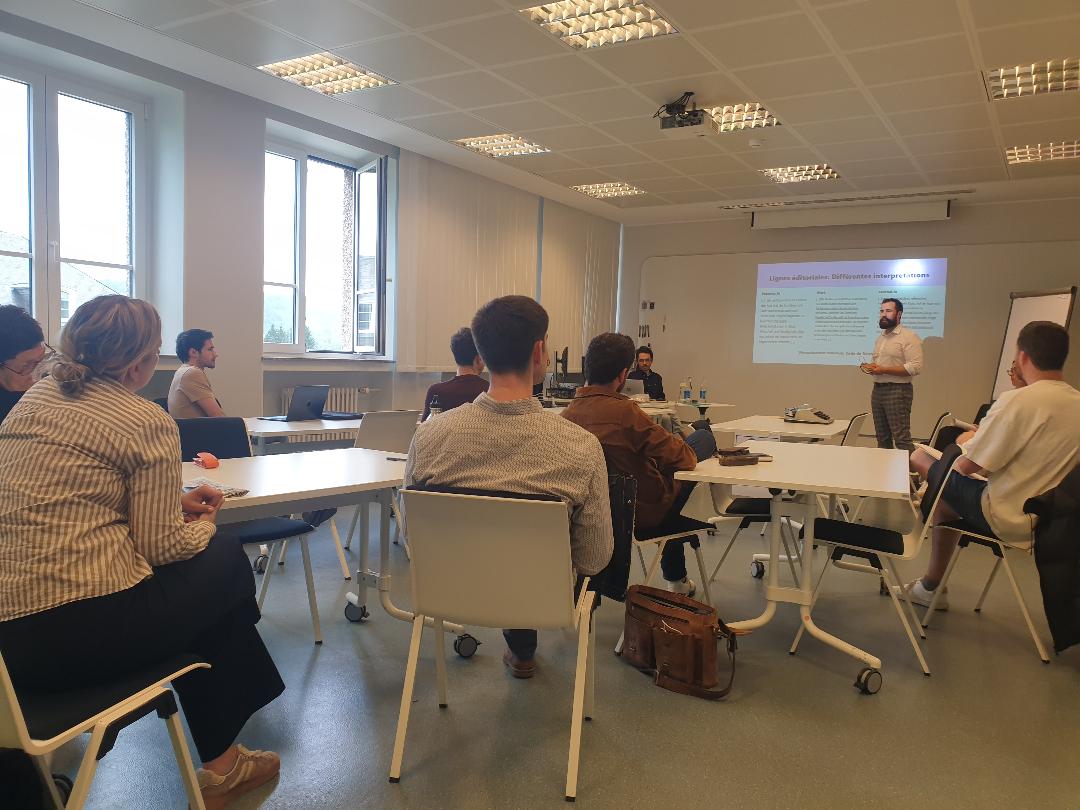
On 5 May, ALIA, in partnership with the Press Council, Zentrum fir politesch Bildung (ZpB) and the Institut de Formation de l’Éducation Nationale (IFEN), offered teachers a training course entitled: “Media in the Classroom: Understanding the Fourth Estate with Students”.
A rapidly evolving media landscape
In a context where access to information increasingly takes place via social media and other digital platforms, traditional media now operate alongside a wide range of new information actors: alternative media, content creators, anonymous actors and inreasingly, AI-based conversational agents.
This proliferation of sources and channels contributes to an increasingly fragmented and algorithm-driven information space, in which journalistic content, political communication, public relations, opinion, advertising, entertainment, disinformation and propaganda coexist.
Understanding the role of the Fourth Estate
Participants explored in particular the concept of the “Fourth Estate”, which refers to the essential role of the press in a democracy: informing citizens, providing critical scrutiny of political and economic power, and contributing to public debate. While fundamental, this concept that may today appear increasingly abstract.
Several questions were addressed:
- What role does the press play in a democracy?
- What defines professional journalism?
- What mechanisms are designed to ensure its independence and accountability?
- What ethical standards and professional obligations distinguish journalistic work from that of other information providers?
The role of regulatory institutions
The training also provided insight into the role and functioning of media regulation and self-regulation bodies, as well as how their respective missions contribute to a coherent framework for the media landscape in the face of the growing convergence of formats and platforms.
The training addressed a number of practical questions:
- How can problematic or illegal content be reported, and how can the appropriate contact points be identified in each case?
- What remedies are available to individuals affected by media coverage or experiencing harm online?
- How can citizens help limit the spread of harmful or illegal content?
Direct dialogue with media professionals
Concrete exchange with media professionals gave teachers insight into ongoing changes in the media landscape, journalistic processes designed to ensure the quality and reliability of information, and the regulatory framework in which media supervisory authorites operate.
Strengthening media and information literacy in the classroom
Beyond the discussions and theoretical input, the training offered participants avenues for reflection on how to translate their understanding of the media system into classroom practices.
The training course will be offered on a regular basis
Given the constant evolution of the media landscape and digital practices, the partners will now offer this training twice a year. This regular format will make it possible to gradually incorporate new trends, recent developments and emerging issues relating to information and media.
The next dates will be announced in due course.